How to install pocket door handles
The importance of pocket door furniture is demonstrated in its design, and the need for items to work alongside the intrinsic design of the pocket door itself. The everyday use of pocket doors is simple and functional. Doors need to be easy to open and close and they need to function in tune with the general flow and movement of the property in question. Handles come into this equation, but with a significant difference.
How are pocket door handles different to other door handles?
It is easy to understand why a door needs a handle and what function it provides, but with a pocket door, the handle requires careful consideration. The pocket door operates by sliding along an overhead rail in order to open. It opens into a wall cavity known as the ‘pocket’ and effectively disappears from view, and this pocket is usually only a few millimetres wider than the thickness of the door itself. In order for the door to open into the pocket there can be no obstructions to this free movement. For this reason, pocket doors are usually flat and plain and don’t have panels or mouldings which essentially increase the thickness of the door and can cause an obstruction when opening the door into the pocket. The same applies to pocket door handles.
So it is not possible to have a regular door handle on a pocket door. These will protrude too far from the door and will bang into the walls of the pocket cavity when attempting to open the door. Instead, pocket door handles need to be flush to the door, and hence the design most popularly used is the flush pull handle.
Describing the pocket door handle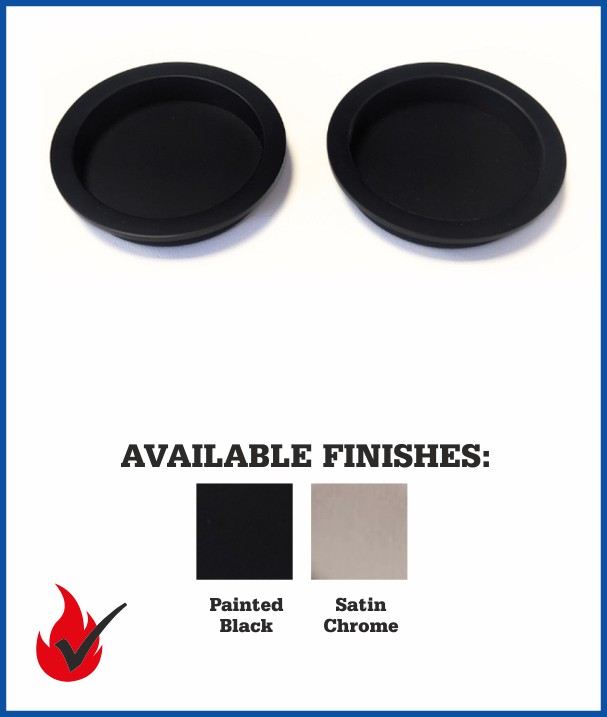
Flush pull handles are a very simple design. It is usually a circular design which sits in a recess in the door and enables the user to insert their fingers and gain traction by pulling on the edged rim built into the recessed design. This enables the handle to sit flush in the door, and therefore it doesn’t cause an obstruction or a hazard to the door opening.
Pocket door handles are usually two-sided with identical flush pull rings on either side of the door. This provides a neat symmetry and makes installation very straightforward, while also providing pocket door furniture that works aesthetically as well as practically. Some designs will also provide a locking system, for internal security and privacy, such as for toilets, bathrooms (check out our bathroom pocket doors range) or an en-suite. Pocket door handles can be supplied in a range of finishes – such as satin chrome, polished chrome, brass and painted black - to suit other elements of your internal design, such as hinges, sockets and switches.
Considerations when installing a pocket door handle
You need to measure a suitable point in the door where the handle will be located. This should be central in terms of height and should be close to the edge of the door. You can trace around the circular door pull and draw a circle on the door. This is the area that will need to be morticed out of the door in order to insert the inlay section of the pull handle. Before attempting to create the mortice you should clamp two blocks of wood, one either side of the door. This sandwiches the door and reduces the pressure in the door edge. If you don’t do this you risk splintering the door when working on it.
There are two general methods used to create a mortice:
- Drill and chisel – Drill several holes within the traced circle and then use a chisel and hammer to knock and prise out the wood within the circle.
- Router – Use a router with a straight bit to create a consistent and clean mortice.
Both methods require an element of skill and it is important that you have a clean and flat mortice in which you can insert the handle hardware. Of course it is also essential that you measure the depth of the hole required by comparing it to the handle hardware.
Once the insert is located within the mortice you can screw the insert in place to secure it. If you have purchased a locking handle, you will also need to mortice a hole in the edge of the door. This is for the edge pull and the locking mechanism. You will also need to locate and secure the strike plate in the door frame edge opposite the latch. This needs to be perfectly aligned so the locking mechanism adequately catches the latch.
You can order your pocket door handles and bathroom locking mechanisms from the Pocket Door Shop by browsing our product range here.
‹ Go Back